June 18, 2026
By We Buy NJ Homes Fast
How to Sell a Water-Damaged or Flooded House in NJ
How to sell a water-damaged or flooded house in New Jersey, from insurance and mold to the flood-disclosure law and selling as-is for cash without repairs.
Introduction
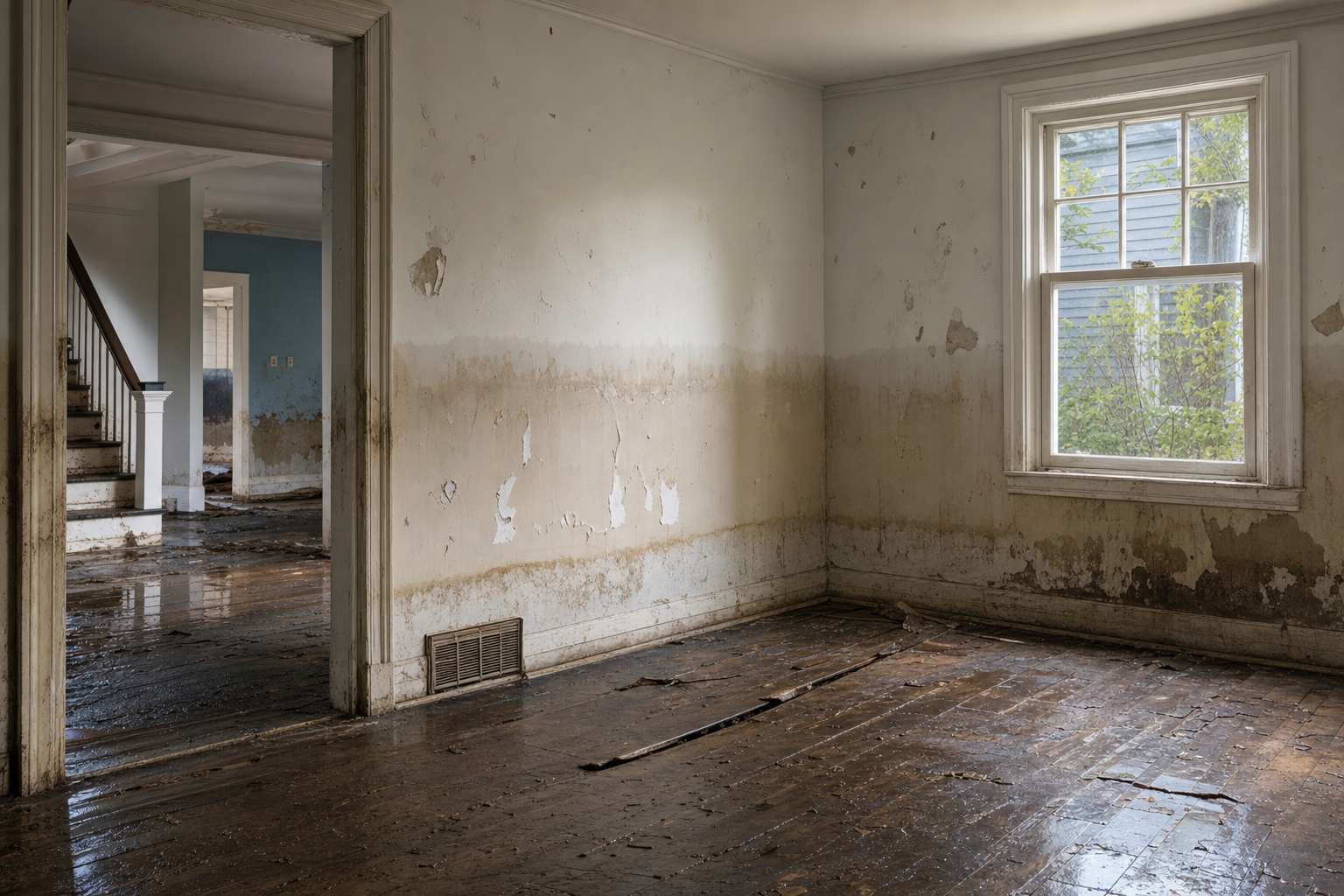
Yes, you can sell a water-damaged house in New Jersey, and you have two realistic ways to do it. You can sell it as-is to a cash buyer who takes the home exactly as it sits, mold and warped floors included, or repair the damage and list it on the open market for a higher price. Either way, New Jersey law now requires you to disclose the home's flood history and water damage, so honesty isn't just decent, it's the rule.
Water damage is uniquely stressful because it rarely sits still. A leak becomes a stain, a stain becomes mold, and a one-time flood becomes a question every future buyer asks. If you're staring at a soaked basement, a burst-pipe disaster, or a home that took on water in a storm, the worst move is to freeze while it gets worse. We buy water-damaged and flooded homes as-is throughout Ocean County, Monmouth County, Bergen County, and all 21 NJ counties, so you have a fast exit if you want one.
First, Stop the Damage and Document Everything
Before you think about selling, slow the bleeding, because water damage compounds. Shut off the source if it's a burst pipe or a failed appliance, get the standing water out, and run fans or a dehumidifier to dry things, since mold can take hold within a day or two of saturation. The faster a space dries, the smaller the eventual problem and the more options you keep.
Then document it thoroughly before you change anything you don't have to. Photograph and video every affected room, the source of the water, and the damaged belongings, because that record is what your insurer, and later your buyer, will rely on. Save receipts for any emergency mitigation. Even if you end up selling as-is to a cash buyer who won't ask for repairs, a clear paper trail protects you on the insurance side and makes your disclosure airtight.
Water damage gets worse and cheaper to ignore at the same time. The longer it sits, the more it costs you, and the more a buyer will discount for the mold they assume is behind the walls.
Water Damage, Insurance, and Who Controls the Claim
Insurance is where water-damage sales get complicated, and the key distinction is what caused the water. A standard homeowner's policy generally covers sudden, accidental damage, like a burst pipe or an overflowing washing machine, but it almost never covers flooding from storms or rising water. Flooding requires a separate National Flood Insurance Program policy, which many homeowners outside mapped flood zones never bought, leaving storm damage entirely out of pocket.
If you do have a valid claim, decide early how it interacts with the sale, because an open claim can complicate closing. In a traditional repair-and-list sale, the proceeds typically go toward fixing the home. In an as-is cash sale, you and the buyer agree on who keeps any pending claim, and a fair buyer prices the home with the damage in mind rather than counting on your payout. Sort this out before you sign anything, since an unresolved claim mid-sale is a common source of delays.
The Mold Question Drives the Price
Mold is what most buyers really fear, and it's the single biggest factor in what a water-damaged home is worth. Beyond the health concerns, mold signals hidden damage behind drywall and under floors, and a mortgage lender's appraiser can flag it hard enough to kill a conventional or FHA loan outright. That's why so many water-damaged homes end up selling to cash buyers, the financing simply falls through for everyone else.
Professional mold remediation isn't cheap, often running from a few hundred dollars for a small, contained spot to $10,000 to $30,000 or more for a home with widespread growth, and that's before repairing whatever the water ruined. You can pay for that work to chase a market-rate sale, or sell as-is and let the buyer absorb it. Neither is wrong, it comes down to your budget, your timeline, and how much of the work you want to manage.
Your Two Ways to Sell
The right path depends on how bad the damage is and how fast you need to move. A home with minor, fully dried damage can often be repaired and listed; a home with serious water intrusion, mold, or flood history usually sells more cleanly for cash.
| As-is cash sale | Repair, then list | |
|---|---|---|
| Best for | Flooding, mold, structural water damage | Minor, contained, fully dried damage |
| Repairs | None, leave it as it sits | Full remediation and repairs first |
| Sale price | Below market, reflects the damage | Closer to market once restored |
| Buyer financing | None, no appraisal to fail | Mortgage, must pass appraisal |
| Time to close | 1 to 3 weeks | Months, after repairs |
| Mold and disclosure risk | Buyer takes it on, priced in | Yours until it's fully fixed |
When Tom's finished basement in Brick flooded during a 2026 coastal storm, he learned his homeowner's policy didn't cover rising water, and a remediation company quoted him north of $18,000 to handle the mold and rebuild. Rather than pour money he didn't have into a house he wanted to leave, he took an as-is cash offer, closed in nineteen days, and walked away with the storm damage now the buyer's responsibility. The discount stung less than the repair bill would have.
What New Jersey Law Makes You Disclose
This is where New Jersey has changed in sellers' favor on the honesty front, and it's worth knowing. Since March 20, 2024, New Jersey's Flood Risk Notification Law (P.L. 2023, c.93) requires sellers to tell buyers about a property's flood risk and history before the buyer is contractually committed, including whether the home sits in a FEMA Special Flood Hazard Area, whether it's required to carry or currently carries flood insurance, and whether it has ever suffered flood damage. That information goes on the state's updated Seller's Property Condition Disclosure Statement, and the state's official flood disclosure portal spells out the full requirements. Skipping it invites exactly the kind of lawsuit that surfaces years after closing.
On top of the flood rules, New Jersey's longstanding common-law disclosure duty, anchored by the state Supreme Court's decision in Weintraub v. Krobatsch, requires you to reveal known water damage and mold whether you sell as-is or not. The reassuring part is that a legitimate as-is buyer expects all of it and prices it in, so full disclosure costs you nothing and shields you completely. Hiding a flood that happens to repeat is what creates real exposure.
Flood Zones and the Buyers You'll Attract
If your home sits in a FEMA-designated flood zone, that fact follows the house and shapes who can buy it. A mortgage lender will usually require the buyer to carry flood insurance, and rising premiums under the federal program have made some buyers wary of flood-zone homes altogether. A history of repeated flooding narrows the pool further, since cautious mortgage buyers walk away from anything that looks like a recurring problem.
Cash buyers are the exception, because they're not bound by a lender's flood-insurance requirement or an appraiser's verdict, and they evaluate the home on its actual numbers rather than its flood-map label. That's why flood-zone and previously flooded homes so often trade for cash. If your house has been through a fire as well, or simply needs more work than water alone, our guides on selling a fire-damaged house and selling a house as-is in New Jersey cover those angles in depth.
Should You Fix It First, or Sell As-Is?
The repair-or-sell decision really turns on three questions, so answer them honestly before you spend a dollar. How severe is the damage and is mold involved, how much cash and time can you put toward repairs, and how fast do you need to be out from under the house? Minor, contained, fully dried damage with no mold is the case where paying to repair and listing on the open market tends to pay off, because you'll recover the repair cost and then some in a higher sale price.
The math flips when the damage is serious. Once you're looking at structural water damage, widespread mold, or a repeat flood history, the repair bill climbs, the timeline stretches into months, and mortgage buyers start dropping out over financing and insurance. At that point the money and effort you'd sink into restoration often won't come back in the sale price, and a clean as-is cash sale protects more of what's left. There's no universal right answer, only the one that fits your damage, your budget, and your deadline.
When a pipe burst behind Elena's kitchen wall in Edison in early 2026, her homeowner's policy covered it, the water was caught within hours, and a contractor dried and repaired everything cleanly with no mold. Because the damage was sudden, insured, and fully resolved, she repaired first and listed on the open market, recovering the cost in a near-market sale. Her situation was the mirror image of a flood, which is exactly why the same house in two different scenarios calls for two different strategies.
Conclusion
Selling a water-damaged house in New Jersey comes down to a few clear moves. Stop and document the damage, understand whether your insurance actually covers the cause, disclose the flood and water history the way state law now requires, and then choose your path based on the severity. Minor, dried-out damage can be repaired and listed for top dollar, while flooding, mold, or a flood-zone address usually sells faster and cleaner for cash, with the repairs becoming someone else's project.
Have a flooded or water-damaged home you'd rather not pour money into? Contact the We Buy NJ Homes Fast Team for a confidential, no-obligation cash offer. We buy houses with water damage, mold, and flood history exactly as they sit, across all 21 New Jersey counties, and can close on your timeline.
Disclaimer. This content is for informational purposes only and does not constitute legal, financial, or tax advice. Laws and programs change frequently, and individual situations vary significantly. Always consult with qualified professionals for advice specific to your situation.